


The Battle of the Corridors: How Africa Is Capitalizing on the U.S.-China Rivalry

Updated: 1 day ago

Executive Summary and Global Stakes
The global energy transition, the decarbonization of heavy industry, and the digital revolution have redrawn the geopolitical map. Strategic minerals and critical metals lie at the very heart of this transformation. Africa, home to a disproportionate share of deposits that have become indispensable to the civilian economy and global security, has thus emerged as the primary theater of a new Cold War.
For over two decades, China exercised near-total dominance over the continent’s mining extraction and logistics networks through its Belt and Road Initiative (BRI). However, growing awareness in Western capitals regarding the extreme vulnerability of critical supply chains has prompted the United States and the European Union to mount an extensive counter-offensive.
The primary strategic challenge is no longer confined to securing mining concessions; it centers above all on controlling export infrastructure: heavy-haul railways, logistics corridors, and deep-water ports. The velocity and cost of transporting these raw materials to world markets have become decisive determinants of global industrial competitiveness.
The Critical Minerals Cold War
On April 2, 2025, the international community was caught off guard by President Donald Trump’s announcement on Truth Social detailing reciprocal tariffs that the United States intended to impose indiscriminately on its trading partners. The announcement alone unsettled global markets, triggering sharp losses across Asian and European bourses.
Amid this uncertainty, market observers focused intently on the response from China, the world's second-largest economy and leading exporter. The crisis, driven upward by retaliatory tariff escalations, de-escalated unexpectedly: Beijing revised its export control list to encompass rare earth elements. The impact was instantaneous: several American industrial manufacturing lines slowed down or ground to a halt. The rationale is stark: according to the International Energy Agency (IEA), China commands approximately 90% of global rare earth processing capacity and 70% of worldwide extraction.
Caught in this geopolitical vice and lacking immediate alternative supply routes, the White House was forced to relent and scale back portions of the tariffs levied on Beijing. While that specific dispute subsided, it exposed the structural dependence of the United States on China for upstream strategic inputs. "We never want to go through what we went through again," Donald Trump declared, justifying a strategic counter-strategy designed to eliminate vulnerabilities in American supply chains.
Within this context of escalating competition, Washington engaged in a direct showdown with Beijing, playing out significantly on African soil. For the West, however, prevailing over Beijing requires challenging Chinese dominance not only in extraction, refining, and processing—segments where China remains largely uncontested—but crucially in securing export logistics, a strategic choke point that Beijing has yet to fully lock down.
The Bottlenecks of Processing and Evacuation
To counter China’s structural lead—anchored upstream in extraction and refining, and downstream in processing and industrial integration—the United States and its allies are deploying a multifaceted strategy. Development finance institutions, such as the U.S. International Development Finance Corporation (DFC) and the Export-Import Bank of the United States (EXIM Bank), are deploying multi-billion-dollar financing facilities (ranging from $500 million to several billion dollars) to back logistics and industrial assets, mobilize capital to secure critical mineral supplies, and sustain continuous diplomatic engagement with African governments.
Concurrently, African producing nations are intent on capitalizing on this leverage to permanently dismantle the extractive colonial trade paradigm. Governments are no longer willing to undersell raw endowments, translating economic sovereignty into enforceable policy:
Comprehensive Restrictive Legislation: Following Zimbabwe in December 2022, countries including Namibia (June 2023), Kenya, Ghana, and Nigeria enacted strict bans or severe restrictions on exporting raw lithium and unprocessed ores. The explicit objective is halting the offshore flight of economic value and compelling foreign operators to establish domestic beneficiation plants.
Building Regional Industrial Value Chains: In March 2023, the Democratic Republic of the Congo (DRC) and Zambia formalized the creation of a cross-border Special Economic Zone (SEZ) dedicated to producing battery precursors and cathode active materials (notably at the Musompo pilot site near Kolwezi). While this ambitious undertaking remains in land-clearing and power-infrastructure phases, the underlying objective is unwavering: because refined and processed metals capture 5 to 10 times the market value of raw run-of-mine ore, the continent refuses to remain a mere exporter of unprocessed rock.
This industrial agenda faces two structural hurdles:
The Energy Deficit: Operating smelters, refineries, and cathode manufacturing plants requires uninterrupted baseload power on the order of hundreds of megawatts (MW). Consequently, concession frameworks now mandate that international developers co-finance hydroelectric dams or utility-scale solar plants to power these downstream industrial assets.
Security Risks and Logistics Fluidity: While unprocessed bulk ores tolerate transit delays and minimal surveillance, transporting high-purity cathode copper or refined cobalt compounds requires hardened freight logistics (real-time GPS tracking, dedicated anti-theft railway security) alongside digitized customs clearance corridors to eliminate costly border bottlenecks.
Regardless of processing levels, access to maritime routes remains the fundamental bottleneck for African resources. Premier mining basins like the Central African Copperbelt (DRC–Zambia) and Guinea's Forest Region lie hundreds or thousands of kilometers inland. Mastery over rail corridors and deep-water ports has thus become the cornerstone of modern industrial sovereignty.
The Infrastructure Duel
Securing logistical corridors to move ore to global refining and processing hubs has become as critical as holding the underlying mineral rights. This reality is underscored by the intense competition between Western powers and China across Africa's prime mineral basins.
Among the various corridor initiatives underway, two flashpoints capture this strategic contest:
West Africa: The Simandou Corridor, featuring the 650-kilometer Trans-Guinean Railway built entirely within Guinea to evacuate ultra-high-grade iron ore from four consortium blocks to the port of Morébaya; and the Liberty Corridor (~250 km), a cross-border logistics link designed to transport iron ore from Mount Nimba through Liberia to the deep-water ports of Buchanan and Didia.
Central and Southern Africa: The Lobito Corridor, backed by the U.S. DFC, which directly counters the historic TAZARA railway, currently being rehabilitated with financial and operational backing from Beijing.
This infrastructure rivalry highlights contrasting operational methodologies and capital-allocation frameworks:
The Chinese Model (Vertical Integration): Beijing relies on state-owned enterprises (CRCC, China Baowu) and state policy banks to execute rapid, turnkey engineering projects. Its core objective is securing direct, dedicated, and uninterrupted feedstock for domestic manufacturing complexes and smelters on mainland China.
The Western Model (Partnership and Consortium Finance): Operating through the G7's Partnership for Global Infrastructure and Investment (PGI), Western governments seek to challenge China's dominance by catalyzing private capital through sovereign risk guarantees and public concessions. The model prioritizes contractual transparency, high ESG (Environmental, Social, and Governance) standards, and open-access, multi-user infrastructure.
Guinea: The High-Grade Iron Ore Strategic Pivot
While benchmark iron ore is not formally categorized as a critical mineral, ultra-high-grade ore (grading above 65–66% Fe) is a vital resource for decarbonization. Producing "green steel" without coking coal relies on Direct Reduced Iron (DRI) electric arc furnace technology powered by hydrogen. Yet DRI-grade deposits account for less than 5% to 10% of proven global reserves. This geological reality places Guinea at the center of international competition: its deposits, grading consistently above 65–66% Fe, represent one of the few global reserves capable of supplying zero-carbon steelmaking at scale.
A. The Sino-British Consortium and Simandou's Scale
For two decades, the Simandou deposit remained stalled under successive civilian administrations. The immense capital expenditure required (exceeding $20 billion) and protracted disputes over concession boundaries continually deferred development.
The deposit is divided into two distinct concessions of immense commercial scale:
Simandou North (Blocks 1 & 2): Operated by the Chinese-led Winning Consortium Simandou (WCS) alongside Baowu, with a planned nameplate output of 60 million metric tons per annum (Mtpa).
Simandou South (Blocks 3 & 4): Controlled by the Simfer joint venture, uniting Anglo-Australian mining major Rio Tinto (53%) with a Chinese state consortium led by Chinalco and Baowu (47%), likewise targeting 60 Mtpa.
Rio Tinto held the legacy mineral rights but lacked both the capital resources to single-handedly fund a 650-kilometer greenfield heavy-haul railway and the commercial certainty of off-take outside the Chinese domestic market. In 2010, Rio Tinto partnered with Chinalco on Blocks 3 and 4. Nonetheless, procedural delays persisted until 2022, when the military government of Colonel Mamadi Doumbouya issued a binding ultimatum: the competing concessionaires had to jointly finance, build, and operate a single, shared national rail and port corridor, or forfeit their mining conventions within 14 days. Faced with license revocation, Rio Tinto and the Chinese partners incorporated the Compagnie du Transguinéen (CTG), cementing an operational and financial partnership to construct the railway and the port of Morébaya.
B. Mount Nimba: Cross-Border Logistical Agility versus Greenfield Megaprojects
Just 160 kilometers away sits Mount Nimba. Holding an estimated resource exceeding 1 billion tons of ultra-high-grade iron ore (65% Fe), the concession—originally divested by BHP—was acquired in 2019 by American-Canadian mining financier Robert Friedland through High Power Exploration (HPX / Ivanhoe Atlantic).
Backed by American institutional investors and the DFC, HPX is advancing the Liberty Corridor at a projected cost of $1.8 billion. This stark capital expenditure differential compared to Simandou stems from two structural factors:
Brownfield Upgrades vs. Greenfield Development: While Simandou requires cutting an entirely new 650-kilometer heavy-haul line across Guinea's mountainous terrain alongside building the greenfield port of Morébaya (costing over $15 billion alone), Mount Nimba sits roughly 250 kilometers from the Liberian deep-water port of Buchanan. The American project leverages the existing Liberian railway (operated by ArcelorMittal), requiring only operational upgrades, capacity expansion, and a short cross-border spur.
Design Capacity: Simandou is engineered for a massive volume of 120 Mtpa, necessitating custom-built heavy-haul rolling stock and high-throughput marine terminal infrastructure. Mount Nimba targets an agile, phased initial production run of 30 Mtpa.

Guinean Iron Ore Export Corridors: Simandou to the Guinean Coast (Blue) vs. Liberty Corridor through Liberia (Pink)
This dynamic presents a notable technical paradox: to operate heavy-haul freight across the Trans-Guinean line, Rio Tinto’s joint venture ordered 30 heavy-haul locomotives from American manufacturer Wabtec's plant in Pittsburgh ($1.2 billion). The underlying engineering requirement was straightforward: American locomotive manufacturers hold a practical monopoly on high-adhesion, 32-tonne axle-load diesel-electric locomotives capable of traversing tropical mud and rugged terrain. Consequently, the iron ore most critical to China's industrial baseline will be hauled by American locomotives.
C. Tangible Strategic Gains for the Guinean State
Departing from legacy resource models where raw materials left the country with minimal domestic reinvestment, Guinea has extracted substantial structural commitments:
Equity Participation and Carried Interest: The Guinean state secured a 15% non-dilutable, free-carried equity interest across all mining operating vehicles (Simfer and WCS) as well as the Compagnie du Transguinéen (CTG) infrastructure operator.
Multi-User Open-Access Assets: Ownership of the 650-kilometer Trans-Guinean railway and the deep-water port of Morébaya will fully revert to the Guinean state after 35 years. The governing convention mandates multi-user open access, enabling passenger rail travel, agricultural freight transit, and commercial cargo handling, providing permanent transport infrastructure for the previously landlocked Forest Region.
Macroeconomic Revenue Generation: At steady-state commercial output, combined operations at Simandou and Mount Nimba are projected to generate $2 to $3 billion in annual fiscal revenues for the Treasury, effectively doubling the national budget.
Domestic Beneficiation and Employment: Over 40,000 direct and indirect jobs are generated across construction phases. Crucially, the ratified mining agreements obligate consortium partners to construct domestic pelletizing plants and secondary smelting capacity, initiating domestic steel transformation.
D. The Conspicuous Absence of the Former Colonial Power
Amid this geopolitical contest among Chinese capital, Anglo-American mining majors, and U.S. commercial diplomacy, France is notably absent. This disengagement stems partly from the diplomatic fallout of 1958, when Sékou Touré’s Guinea rejected the French Community, initiating decades of bilateral estrangement. Yet the underlying constraint is fundamentally industrial: unlike the United Kingdom (via Rio Tinto) or the United States, France no longer maintains diversified global mining conglomerates or heavy primary steelmakers capable of executing greenfield infrastructure megaprojects exceeding $20 billion. Having concentrated its African corporate footprint in telecoms, commercial logistics, and utilities, Paris remains an outside observer as Guinea’s mineral wealth is developed.
The Copperbelt: The Continent’s Mining Heartland
In Central Africa, the battle for logistical control centers on the mineral heartland of the continent: the Copperbelt (spanning the DRC and Zambia), the world’s preeminent source of mined cobalt and high-grade copper. Two heavy-rail logistics lines compete to evacuate these strategic minerals.
A. TAZARA: The Legacy Chinese Lifeline
Engineered between 1970 and 1975 under Mao Zedong, the 1,860-kilometer Tanzania-Zambia Railway Authority (TAZARA) line established China’s contemporary diplomatic and economic footprint in Africa. Designed to bypass white-minority regimes and provide landlocked Zambia an independent maritime outlet, it historically linked the Copperbelt to the Port of Dar es Salaam on the Indian Ocean. Following decades of under-investment and low operational availability, TAZARA’s revitalization was accelerated directly in response to Western backing of the Lobito Corridor. Under a 30-year concession granted to state-owned China Civil Engineering Construction Corporation (CCECC), Beijing is deploying $1.4 billion to rebuild the permanent way, reinforce bridge structures, and deliver 32 new locomotives alongside 700 freight cars. This restored capacity is positioned to channel bulk copper concentrates, copper anodes, and manganese ores mined by Chinese state operators in the DRC and Zambia (such as CNMC) directly to coastal processing complexes in mainland China.
B. Lobito: The Western Counter-Offensive
While running along the alignment of the historic Benguela Railway, the modern strategic iteration of the Lobito Corridor is a recent development. Accelerated from 2022 to 2023 by Washington and the European Union under the G7’s PGI, this 1,300-kilometer rail corridor links Congolese and Zambian mining basins directly to the Angolan deep-water Atlantic port of Lobito, cutting maritime transit times to Western ports from 30 days to under a week.
Backed by $2.5 to $4 billion in mobilized funding, the Lobito Corridor has shifted into active operation. The Kolwezi–Lobito rail section is operating under a 30-year concession run by the Lobito Atlantic Railway (LAR) private consortium. The U.S. DFC contributed an initial $553 million senior debt facility, complemented by over €500 million committed by the EU for digital systems, cross-border border posts, and ancillary power generation. The next phase centers on constructing a greenfield rail link connecting Zambia directly to the Angolan mainline. In the interim, Lobito functions as the primary Atlantic exit for high-grade refined copper cathodes, battery-grade cobalt hydroxide, and zinc extracted from world-class Congolese operations (such as Kamoa-Kakula and Tenke Fungurume), routing materials directly to Western gigafactories and defense supply chains.
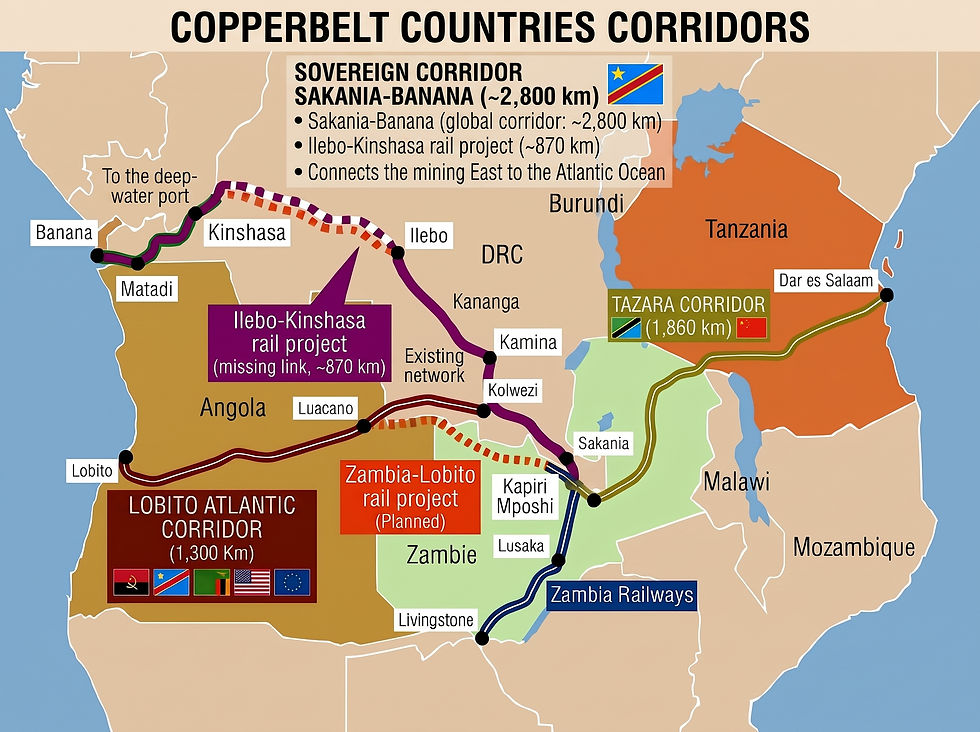
C. Are Trans-Continental Connections (Lobito–TAZARA) Feasible?
On a map, physical track connection exists at the Kapiri Mposhi junction in Zambia: a freight train could theoretically cross the African continent from the Atlantic at Lobito to the Indian Ocean at Dar es Salaam. Yet two technical and operational barriers prevent transcontinental integration:
Track Gauge Incompatibility: The Lobito Corridor and the domestic networks of the DRC and Zambia use the 3-foot-6-inch Cape gauge (1,067 mm), whereas TAZARA was constructed to the 1,000 mm meter gauge. Connecting the networks requires physical transshipment of freight or complex variable-gauge rolling stock.
Freight Market Competition: The two corridors are operated by competing commercial consortia (Western-aligned operators on Lobito, Chinese state entities on TAZARA). Consequently, the Copperbelt junction does not function as an interconnected hub, but rather as an arbitrage point where mining houses decide whether to route tonnages west toward the Atlantic or east toward the Indian Ocean.
Strategic Choices and National Sovereignty
The rapid emergence of competing logistics corridors confronts African governments with complex policy trade-offs regarding cross-border routing versus domestic port development. In Guinea, developing the Liberty Corridor at $1.8 billion offers lower upfront capital costs than building the $24 billion Trans-Guinean line. Across the Copperbelt, the DRC routes its mineral wealth through Angolan or Tanzanian ports rather than its own coastline. In an ironic historical parallel, Belgian colonial authorities negotiated at length with Portuguese colonial officials in Angola to secure access to the ocean, precisely to protect sovereign export rights over the mineral riches of the Congo Basin.
A. Why $1.8 Billion for Mount Nimba versus over $20 Billion for Simandou?
The wide capital expenditure gap between the $1.8 billion deployed by HPX for Mount Nimba and the $20-plus billion required for Simandou is not driven by ore quality—both hold premium direct-reduction ore above 65–66% Fe—nor by extraction complexity. It stems from a deliberate trade-off between national resource sovereignty and capital efficiency.
From the outset, Guinea made a sovereign deep-water logistics link a non-negotiable prerequisite: Simandou iron ore had to transit exclusively via domestic infrastructure. While this policy eliminated reliance on third-party states, it required heavy capital investment: laying a 650-kilometer heavy-haul railway across challenging topography (requiring dozens of bridges and extensive tunnels) and constructing the deep-water port of Morébaya. The rail and marine infrastructure alone account for over $15 billion of total project capital. The Simandou Corridor represents an immense civil engineering endeavor: laying 650 km of continuous 32-tonne axle-load dual track through greenfield terrain, dredging an offshore maritime channel, and building terminal infrastructure to berth dry-bulk carriers.
Conversely, Conakry granted an explicit cross-border exemption for Mount Nimba. Located in the southeastern interior of the Forest Region, Mount Nimba is geographically landlocked. Recognizing that requiring HPX to build an 800-kilometer domestic link to the Guinean coast would render the project financially unviable, Conakry permitted export through Liberia. By lifting this requirement, HPX reduced the rail transit distance to roughly 250 kilometers, lowering upfront logistical capital expenditure by more than 90%.
B. The Congolese Sovereignty Debate
The strategic decision to rely on external transit corridors—as Guinea permitted for the Liberty Corridor—is the subject of sharp political debate within Congolese policy circles regarding Lobito. Former Prime Minister Samy Badibanga has argued that the DRC must grant absolute priority to developing its own national infrastructure corridor. He identifies the multimodal trans-Congolese Banana–Sakania axis (linking the Zambian border in Katanga to the Atlantic coast) as the essential foundation of the country's economic sovereignty. In his analysis, outsourcing strategic mineral exports to Angola (Lobito) or Tanzania (TAZARA) risks stranding the planned Banana deep-water port and diverting substantial transit fees, tax revenues, and downstream industrial jobs from the national treasury. He proposes a blended financing model drawing on domestic savings, diaspora capital, and public-private partnerships to ensure sovereign logistical control.
Kinshasa thus operates at the intersection of two distinct strategies: the near-term commercial pragmatism of the Lobito Corridor to avoid bottlenecking its mining sector, balanced against the long-term imperative of sovereign domestic transit along the Banana axis. The DRC's long-term infrastructure challenge will involve utilizing the Lobito Corridor in the interim to capture mining export value, while directing capital toward developing internal rail and river links that connect the eastern mining provinces directly to the deep-water port of Banana.
However, the river port of Matadi faces structural limitations: it is a congested inland terminal constrained by the shallow draft of the Congo River and situated nearly 2,000 kilometers from Upper Katanga. Hauling copper and cobalt from Katanga to Matadi across domestic routes exposes shippers to deficient domestic links. In the near term, the 1,300-kilometer Lobito rail line remains the more viable and cost-effective export route for heavy industrial producers. The expansion of Lobito does not obsolete Matadi; rather, it allows it to reposition. Matadi can transition away from bulk mining transit to focus on serving as the primary logistics gateway for consumer goods and container traffic supplying Kinshasa and western provinces.
Strategic Pragmatism and Economic Returns
Rather than remaining passive participants in great-power rivalries, African governments (Angola, Guinea, the DRC, and Zambia) are exercising strategic non-alignment:
Leveraging Geopolitical Competition: Practicing multi-vector diplomacy enables producing nations to negotiate competitive credit terms, secure concession fee reductions, and establish binding technology-transfer agreements.
Broad-Based Economic Spillovers: These railway investments extend beyond mining freight. They open up landlocked agricultural basins, accelerate cross-border commerce, and create local employment.
Enforcing Economic Sovereignty: By encouraging competing investment from both Western and Chinese sources, African states have secured binding commitments for domestic beneficiation that foreign investors historically resisted.
The competition for African logistics corridors reflects a broader realignment of global trade flows under the twin pressures of decarbonization and industrial policy. By positioning the continent as a central arena for strategic infrastructure investment, Sino-American competition provides African governments with fresh economic leverage. If channeled toward regional economic integration and domestic processing, these heavy-haul rail corridors will serve not merely as mineral export channels, but as foundational assets for sustained industrial development across the continent.


Comments